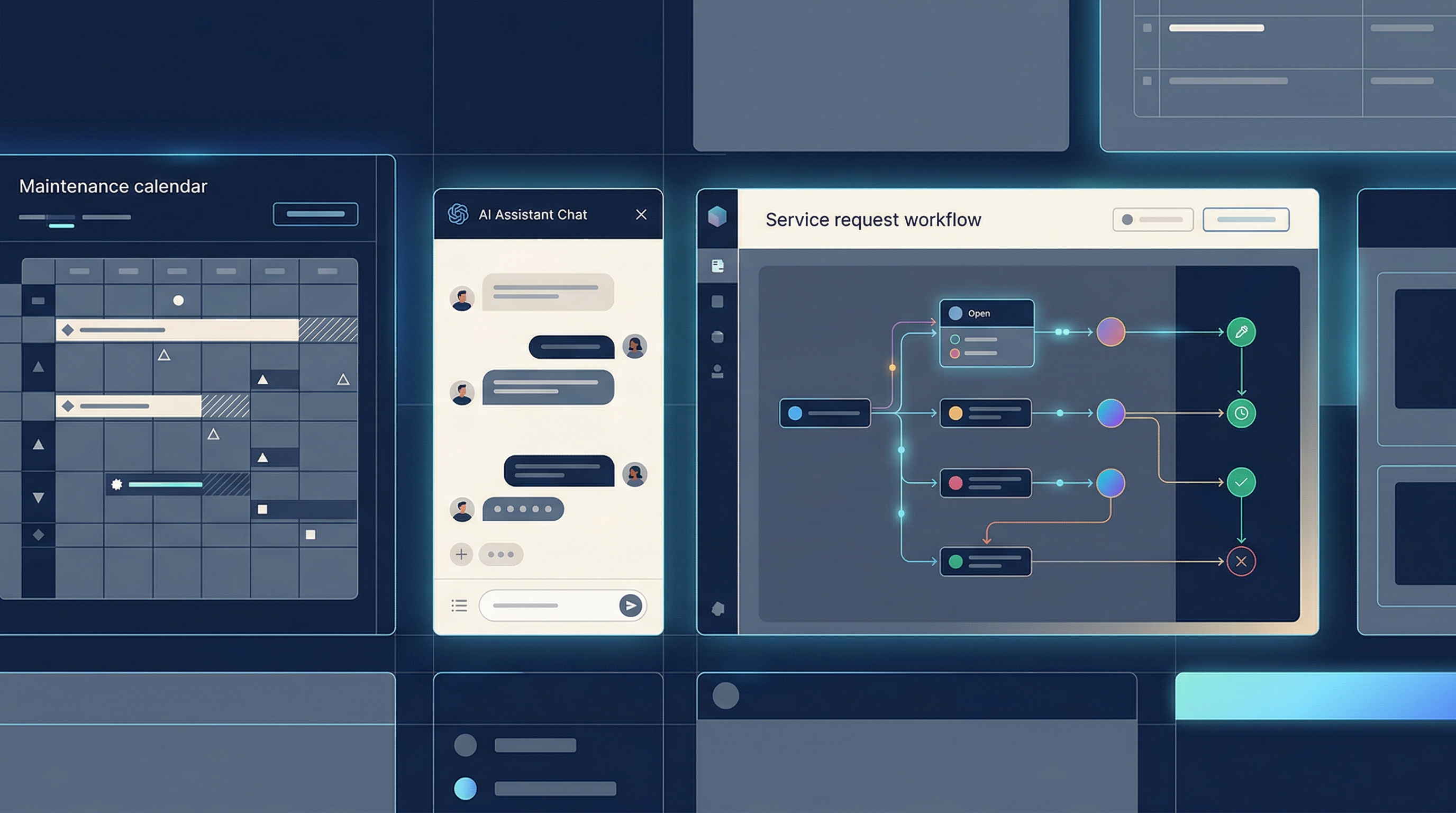
Service in mechanical engineering often means: unstructured requests by email, unclear responsibilities, manual sorting and forwarding. This costs time, ties up resources, and leads to delays. The enhanced AI agent in Transaction-Network's service module changes this fundamentally. It automatically structures incoming service requests, pre-qualifies tickets, and ensures that the right information reaches the right people - without manual intervention.
Automatic Structuring of Incoming Service Requests
Every service manager knows the challenge: requests arrive in different formats, with varying quality, and often without the necessary information.
The AI agent automatically analyzes incoming service requests and structures them:
The result: An unstructured email becomes a structured service case with all relevant information.
This saves time. Not minutes. But hours. With every single case.
- Categorization - Is it a technical fault, a maintenance request, or a documentation request?
- Asset assignment - Which machine is affected? What is its history?
- Priority assessment - How urgent is the request? What are its consequences?
- Information extraction - What relevant details are already available? What is still missing?
Pre-Qualification of Tickets
Not every service request requires the same effort.
Some problems are known and have documented solutions. Others are complex and require expert knowledge.
The AI agent automatically pre-qualifies tickets:
This means: Service teams can focus on the truly complex cases. Standard requests are automatically pre-qualified and provided with solution suggestions.
- Known error patterns - Are there already documented solutions in the knowledge base?
- Similar cases - Have comparable requests already been processed?
- Required expertise - Which area of expertise is needed? Which service partner is responsible?
- Escalation need - Is an immediate response required or can the case be handled regularly?
Pre-qualification is the key to service scalability. Not every case needs an expert. But every expert should only receive the cases that truly require expertise.
The Intelligent Service Assistant in Action
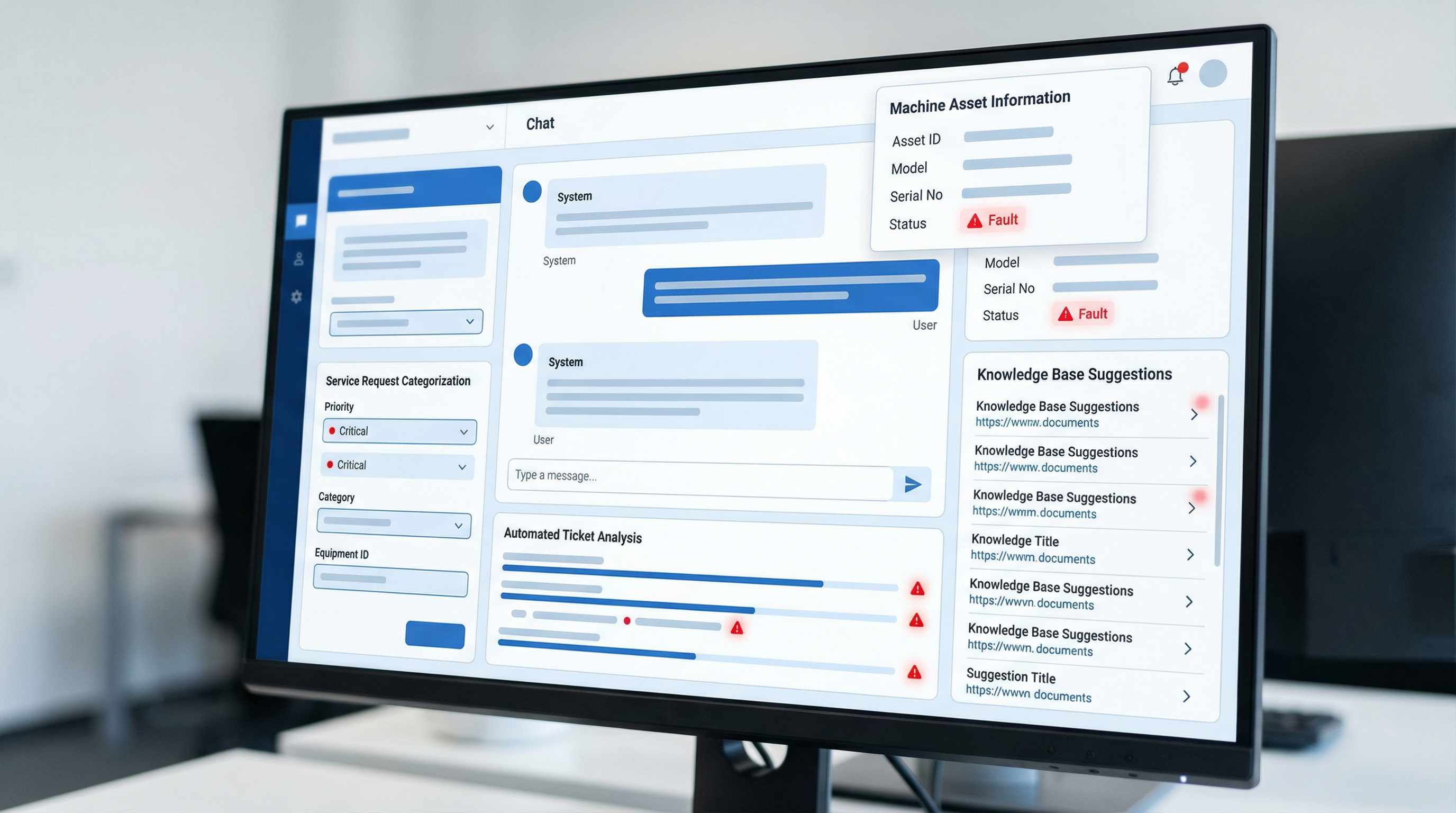
The AI agent in dialogue: structured service requests with automatic analysis and solution suggestions
The AI agent works in the background but is accessible to users at any time.
Service staff can interact directly with the agent, ask questions, and retrieve solution suggestions. The agent accesses structured data spaces - machine histories, documentation, service reports, and knowledge bases.
Human-in-the-Loop for Quality Assurance
Automation is important. But quality is decisive.
That is why Transaction-Network deliberately relies on human-in-the-loop: the AI agent structures, analyzes, and suggests solutions - but the final decision is always made by a human.
This means:
This is not a compromise. This is the right balance between automation and human expertise.
- Quality control - Every automatically generated solution is reviewed by a service employee
- Learning effect - Corrections flow back into the system and improve future analyses
- Responsibility - Responsibility for service decisions remains with the human
- Trust - Customers know that their requests are evaluated by real experts
The Process Flow: From Request to Solution
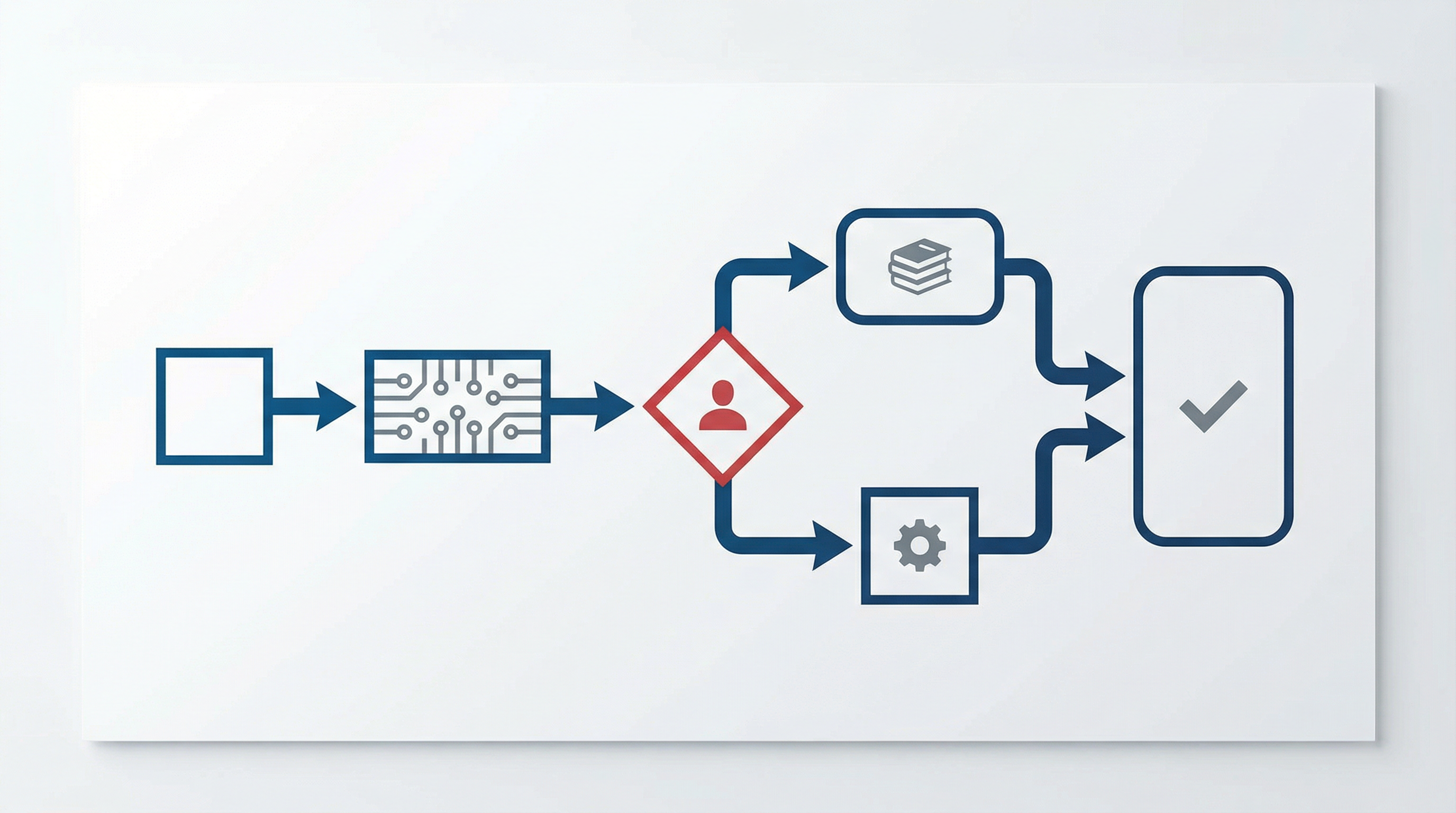
The complete process flow: From unstructured service request to structured solution with AI-powered analysis and human-in-the-loop quality assurance
The enhanced AI agent orchestrates the entire service process:
A request comes in - by email, through the portal, or via API. The AI agent analyzes it, structures the information, assigns it to the correct asset, and suggests a categorization.
In parallel, it checks the knowledge base: are there already documented solutions? Have similar cases been processed? What measures have worked?
A service employee receives the pre-qualified case - with all relevant information, context, and solution suggestions. They decide on the next steps.
The result: Significantly shorter processing times, fewer follow-up questions, higher customer satisfaction.
Reduction of Manual Effort
The numbers speak for themselves:
Without AI support, service employees spend up to 40% of their time on administrative tasks: sorting emails, categorizing requests, searching for information, clarifying responsibilities.
With the AI agent, this effort is significantly reduced:
Concretely this means: Service teams can focus on what really counts - solving problems, supporting customers, getting machines back up and running.
Not administration. But value creation.
- Automatic categorization - No more manual sorting
- Pre-qualified tickets - All relevant information is already structured
- Solution suggestions - Knowledge base is automatically searched
- Clear responsibilities - The right expert is directly assigned
Technical Progress with Immediate Impact
The enhanced AI agent is not a future vision. It is productively in use.
OEMs and producers using the service module are already benefiting from automatic structuring and pre-qualification.
The benefits are measurable:
This is technical progress with immediate impact. Not someday. But now.
- Faster response times - Tickets are immediately categorized and assigned
- Higher solution quality - Solution suggestions are based on structured knowledge
- Better resource utilization - Experts only handle cases that require expertise
- Continuous improvement - The system learns with every processed case
Outlook: Further Automation Steps
The AI agent in the service module is just the beginning.
In the coming months, further automation steps will follow:
The goal is clear: Service in mechanical engineering should not only function reactively, but proactively, in a structured way, and data-based.
The enhanced AI agent is the right foundation for this.
- Proactive error analysis - The agent recognizes patterns and warns before problems arise
- Automated escalation - Critical cases are immediately forwarded to the right people
- Intelligent knowledge generation - Solutions are automatically documented and made reusable
- Predictive maintenance integration - Service data flows into maintenance planning
Automation in service does not mean replacing people. It means freeing people from repetitive tasks so they can focus on what truly requires expertise.