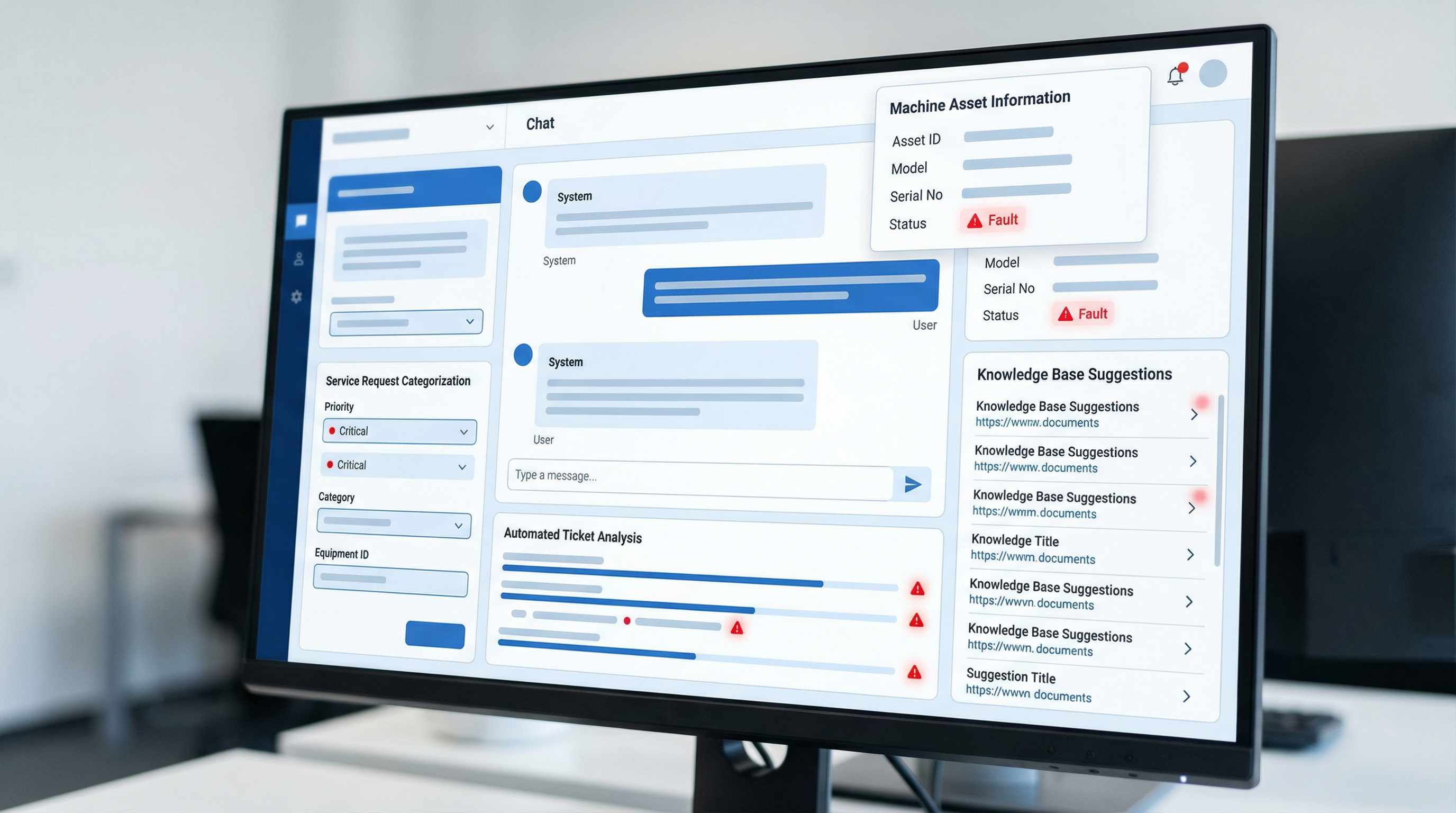
In service, most effort arises not from missing features but from missing structure. Information is scattered, responsibilities are unclear, and collaboration often only works through coordination. This leads to simple topics taking unnecessarily long. These are exactly the points we worked on in the last sprint.
1. AI Assistant Extension with Access to Real Machine Data
The AI Assistant 2.0 can now be activated. It accesses all documents stored directly at the machine in the BOM. This includes, for example, operating manuals, technical documentation, or project-specific documents.
Once these documents are in the system, the assistant can access them and incorporate them into its responses.
This noticeably changes usage: questions no longer relate to general knowledge but to the specific machine and its history.
For manufacturers, there is additionally the option to customize the assistant's behavior. Certain default settings are already stored but can be extended or changed depending on how the assistant is to be used in service.
2. Maintenance Area Fully Available for Manufacturers
The maintenance area is now also fully available to the manufacturer.
Concretely this means: the manufacturer sees the maintenance calendar, the job list, and all tasks and can create, edit, and carry them out.
- Create and plan maintenance tasks
- Define recurring tasks
- Document and complete tasks
- Track ongoing measures
Previously this area was more focused on the operator. With the update, both sides work in the same area and on the same data foundation.
This reduces coordination because information no longer needs to be transferred between systems or people.
3. More Control in Service Requests
Manufacturers can now determine whether parts may be directly linked in service requests.
This allows control over whether a request remains purely descriptive or is directly linked to specific components.
In practice this means: When parts are linked, it becomes clearer faster what the issue is and what next steps are necessary. This reduces follow-up questions and simplifies further processing.
4. Sharing Maintenance Tasks Between Operator and OEM
Operators can now specifically share maintenance tasks with their OEM when creating or editing them.
Once the task is shared, the OEM has access to it and can also edit it.
- Adding information
- Adjusting tasks
- Documenting completed work
Both sides thus work on the same task instead of exchanging information separately.
Summary
This release does not change individual functions in isolation, but above all the interplay.
Access to knowledge, execution of maintenance, and collaboration between operator and manufacturer now fit together more closely.
The goal remains unchanged: to set up service so that it works in daily operations without generating additional coordination loops.