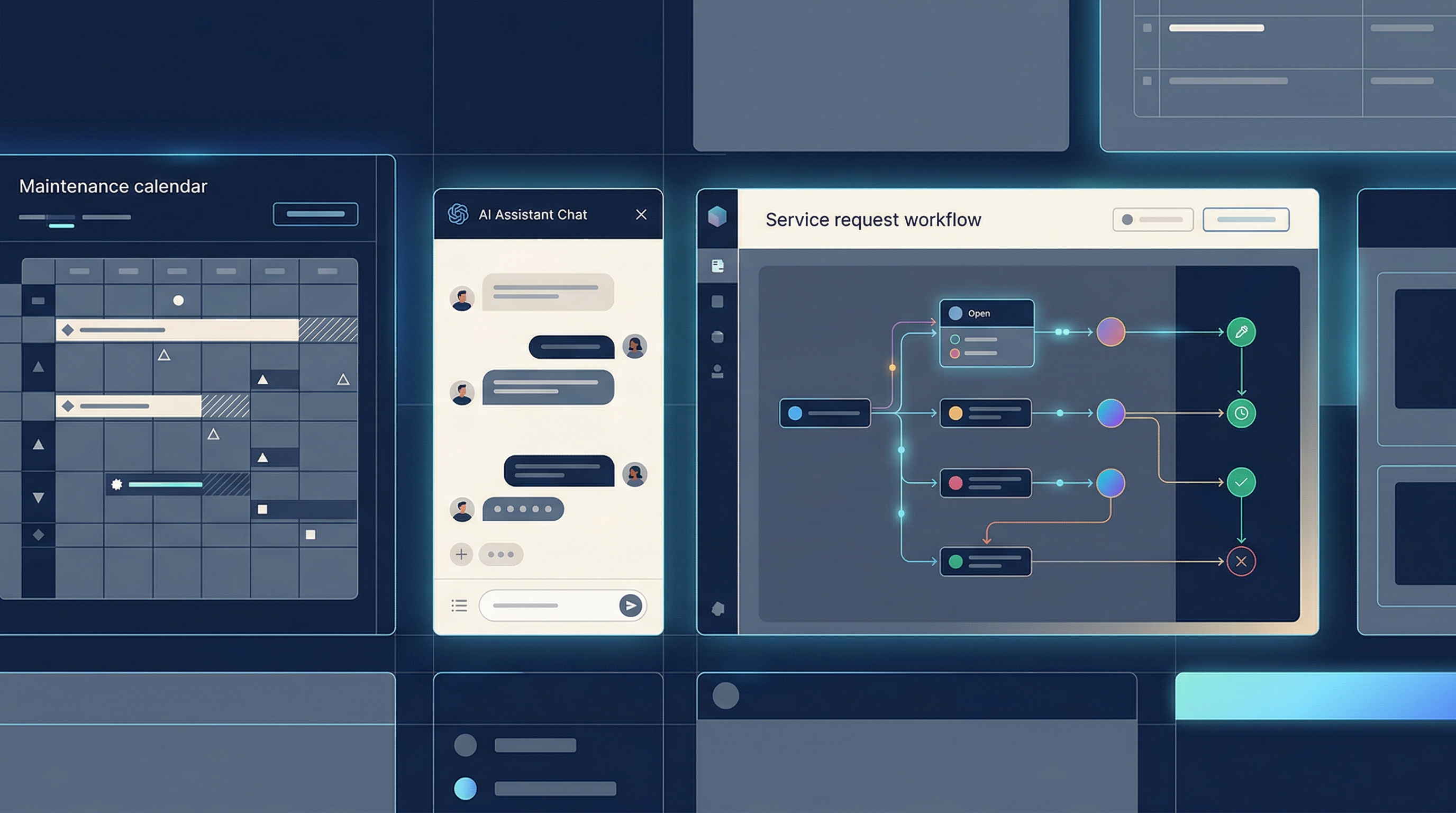
Service in mechanical engineering is under pressure. More complex equipment. Less skilled personnel. Higher availability requirements. Those who only digitalize here will fail. What matters is structure. This is the guiding principle for our platform roadmap 2026 that we have published for our customers. Here is a brief overview.

Strategic Roadmap 2026: Connecting automation, AI agents, and scalability for structured industrial service.
1. Further Development of the Numerous AI Agents
Our AI agents will become significantly more powerful in 2026.
They automatically structure incoming service requests, analyze relationships across assets, histories, and components, and independently suggest solutions - based on the respective data spaces of OEMs and producers.
This means: The agents access structured machine information, service histories, documentation, and existing knowledge and combine this information in a context-specific way.
Human in the Loop is deliberately integrated. The final decision continues to be made by the human. Quality takes precedence over speed.
The goal is clear: Less manual pre-qualification. Less search effort. More genuine relief in service.
2. Expansion of Automation in the Ecosystem
Service does not scale through more personnel. It scales through clear, automated processes.
In 2026 we are expanding the automated handover between operator and OEM. Status changes, escalations, and feedback are systematically guided, no longer improvised by email.
This reduces friction losses throughout the network.
3. Deepening of Data Integration
Data is only valuable when it is structured and linked.
We are deepening the integration of machines with service histories and operational data. The asset becomes definitively the central reference in the service process.
This creates the foundation for reliable decisions.
4. Automated Solution Finding in Service
A central goal of our roadmap is partially automated solution finding.
Recurring error patterns are systematically recognized. Existing knowledge bases are intelligently incorporated. Solution suggestions no longer arise by chance, but data-based.
This shortens response times and increases equipment availability.
5. Expansion of Our CRA Module (Cyber Resilience Act)
With the Cyber Resilience Act, requirements for software manufacturers and operators of technical systems increase significantly.
We are purposefully developing our CRA module to support OEMs and producers in the structured implementation of regulatory requirements.
This includes among others:
The goal is to organize regulatory requirements not as an additional burden, but to structurally integrate them into existing service processes.
For OEMs this means more security in product liability and documentation.
For producers more transparency about the security status of their equipment.
Cyber resilience must not be a parallel process. It must become part of the platform structure.
- Traceable documentation of security-relevant changes
- Structured management of software components and versions
- Transparent update and patch processes
- Clear roles and responsibilities within the ecosystem
2026 at Transaction-Network is about structure, automation, and genuine scalability. Those who think about service strategically must build it in a structured way.