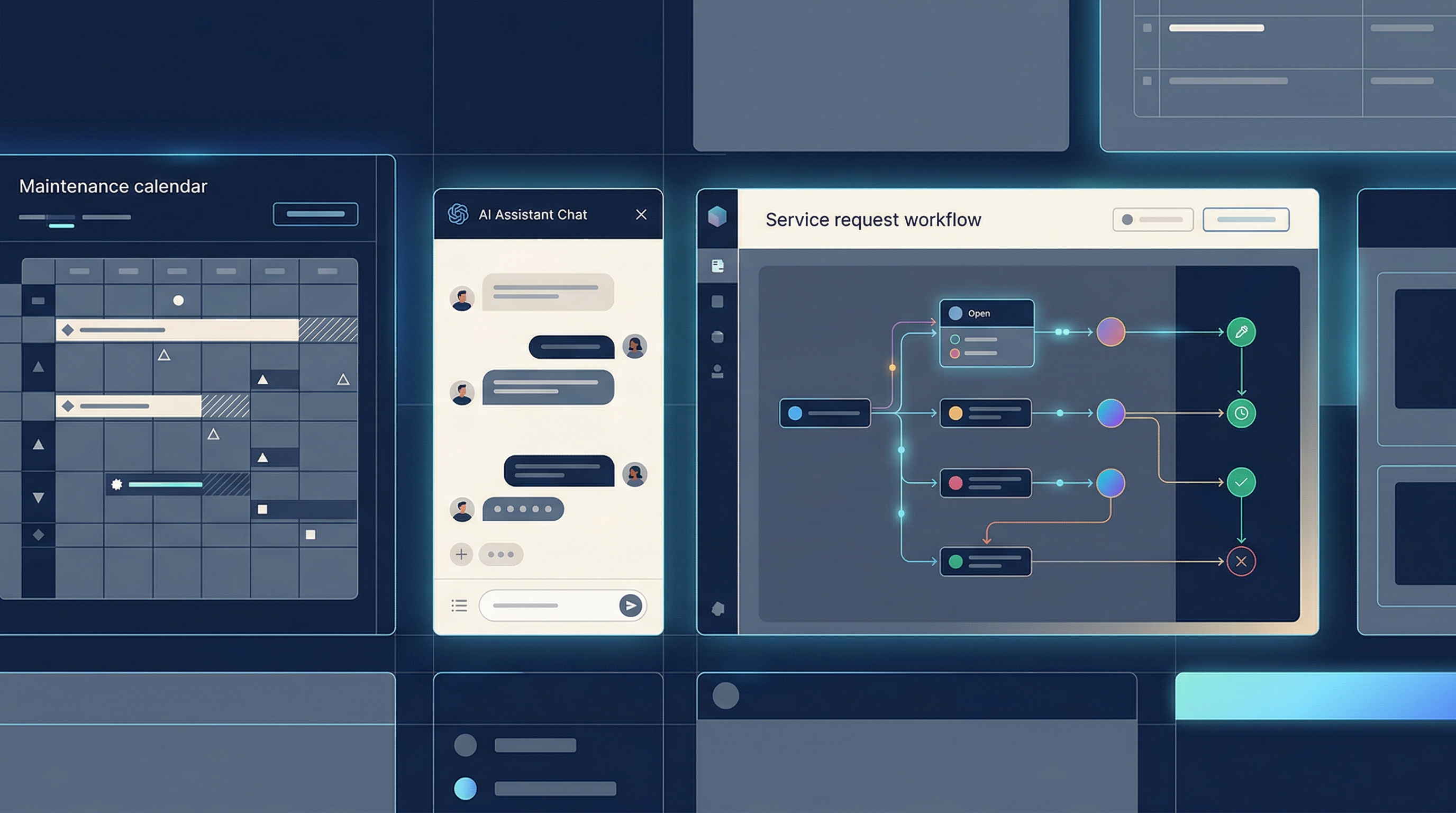
Service in mechanical engineering has changed. In the past, it was about reacting quickly when something happened. Today, customers expect problems not to arise in the first place, or at least to be recognized early.
They want to understand what is happening, they want access to information, and they want processes that work without constant follow-up.
Many companies face exactly this problem. They have systems. Often even several. But these systems do not work together. Information is scattered, processes are not seamless, and at the decisive moment clarity is missing.
Gerhard Schubert GmbH faced exactly this situation.
Starting Point: Strong Service, But Too Many Individual Solutions
Service is a central part of the business at Schubert and contributes a significant portion of revenue.
At the same time, a system landscape has developed over the years that covers many functions but is not thought through seamlessly. There were solutions for bills of materials, for machine data, for evaluations. Each sensible on its own. But together they did not form a closed system.
The real challenge was therefore not to introduce yet another tool, but to connect the existing building blocks in a way that creates a functioning overall process.
The Step to the Platform
Schubert deliberately decided against another isolated solution and instead chose the path of interlinking the existing systems.
With Transaction-Network, a platform was introduced that establishes exactly this connection. Existing applications were not replaced, but integrated and transferred into a common structure.
The goal was clear: a central access point for the customer and a seamless view of all relevant information and processes.
What Changed in Daily Operations
The biggest change is not in individual functions, but in the way work is done.
Information is no longer available in scattered locations, but is bundled in one place. Machines are mapped as digital units, including documentation, bills of materials, and technical relationships.
This has direct effects on daily operations. A service employee finds the right information faster. A customer can track what is happening with their machine. And processes that previously ran via email or phone are handled in a structured way through the platform.
Transparency Instead of Follow-Up Questions
Uwe Galm, Service Manager, Gerhard Schubert GmbH
Today the customer can create a ticket directly themselves. The relevant information is already in the system or is captured in a structured way. At the same time, they see what is happening, who is responsible, and what the current status is.
The result is not a new feature, but a different way of working. Fewer follow-up questions, fewer loops, more clarity on both sides.
It was clear to us that we could not continue developing service with more and more individual solutions. The decisive factor was to create a structure in which all information comes together and processes work seamlessly. With the platform, we have achieved exactly that.
- Uwe Galm, Service Manager, Gerhard Schubert GmbH
Conclusion
Service can no longer be meaningfully organized through individual tools. It needs a structure in which data, processes, and participants are brought together.
Only then does what customers expect today emerge: transparency, reliability, and speed in daily operations.